
Congees
Ginseng & Poria Congee (Shenling Zhou)
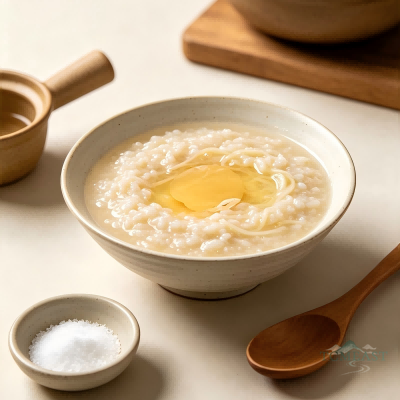
Ginseng & Poria Congee is a classic spleen-strengthening medicinal porridge originating from a legendary formula of Sun Simiao, the "King of Medicine" of the Tang Dynasty. It is recorded in detail in the Song Dynasty medical encyclopedia Shengji Zonglu (General Medical Collection): "Shenling Congee formula treats cold damage, stomach qi disharmony, complete loss of appetite, and gradual emaciation."Legend has it that this congee was once wildly popular in Chang'an, the capital of the Tang Dynasty, enjoyed by nobles and elites. Ginseng greatly tonifies original qi, supplements the spleen and benefits the lungs; Poria promotes diuresis, drains dampness, and calms the mind. Combined with rice to warm the middle and ginger to warm the stomach, this congee achieves the effects of tonifying qi, supplementing deficiency, strengthening the spleen, and nourishing the stomach. The congee is smooth and creamy, with a harmonious blend of ginseng aroma and rice fragrance. Regular consumption strengthens the spleen and stomach, moisturizes the complexion, and promotes longevity—an ideal dietary therapy for those with spleen-stomach qi deficiency and stomach cold.
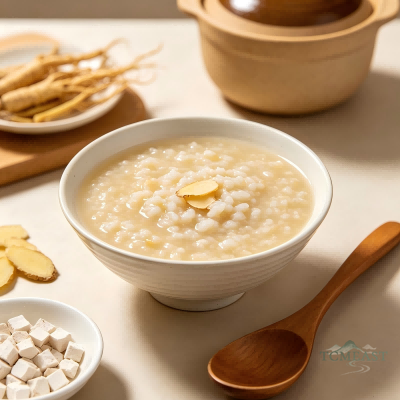
Main Ingredients
- Ginseng 5g
- White Poria (Fuling) 20g
- Japonica rice 100g
- Fresh ginger 5g
- Salt to taste
- Egg white 1 piece
Steps
Slice 5g of ginseng and 5g of ginger thinly. Crush 20g of white Poria. Place all three herbs in a pot, add water, and soak for 30 minutes.
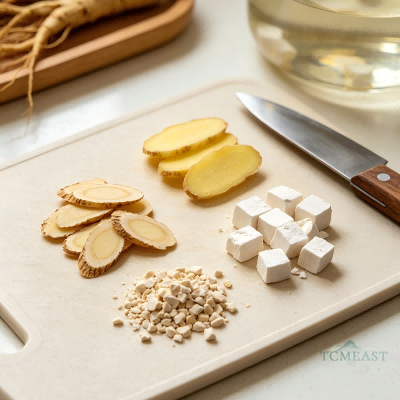
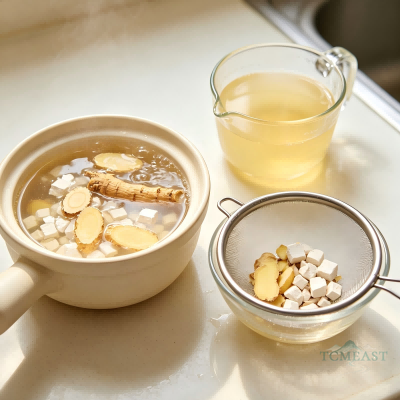
First decoction: Bring the soaked herbs (with soaking water) to a boil, simmer for 30 minutes, strain, and reserve the liquid. Second decoction: Add water to the herb residue again, simmer for 20-30 minutes, and strain. Combine decoctions: Mix the two decoctions together.
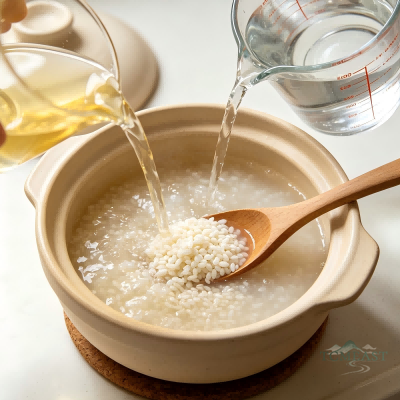
Pour the combined decoction into a pot, add water to reach about 800-1000ml total, add 100g of rinsed japonica rice, bring to a boil, then reduce to low heat and simmer until the rice is fully softened and the congee is thick (about 30-40 minutes).
Add a pinch of salt to taste just before serving, optionally stir in 1 egg white. Consume warm on an empty stomach, divided into morning and evening servings. Take 1 dose daily for 5-7 consecutive days.
TCM Notes
Ginseng: Sweet and slightly bitter in taste, slightly warm in nature; enters the Spleen, Lung, Heart, and Kidney meridians. Known for greatly tonifying original qi, restoring pulse and preventing collapse, supplementing the spleen and benefiting the lungs, generating fluids, and calming the mind. Used for weak constitution with cold limbs, spleen deficiency with poor appetite, chronic illness with emaciation, palpitations, insomnia, and heart failure. Modern research shows ginseng enhances immunity, increases adaptability, and exhibits notable anti-aging effects. Dangshen or Pseudostellaria can be used as milder substitutes with similar effects. White Poria: Sweet and bland in taste, neutral in nature; enters the Heart, Lung, Spleen, and Kidney meridians. Known for promoting diuresis, draining dampness, strengthening the spleen, and calming the mind. Used for spleen deficiency with poor appetite, loose stools, diarrhea, restlessness, palpitations, and insomnia. Modern pharmacology shows Poria contains polysaccharides with immune-enhancing and liver-protective effects. Japonica Rice: Tonifies the middle, boosts qi, and strengthens the spleen and stomach, enhancing the tonic effects of ginseng and Poria. Fresh Ginger: Warms the middle, stops vomiting, and disperses cold; enhances the stomach-warming effects when combined with ginseng and Poria. Synergistic Effect: Ginseng greatly tonifies original qi, Poria strengthens the spleen and drains dampness, rice nourishes the stomach and boosts qi, ginger warms the middle and disperses cold. Together, they achieve the effects of tonifying qi, supplementing deficiency, strengthening the spleen, and nourishing the stomach. Total approx. 300-400 kcal, primarily carbohydrates – a warming medicinal porridge.
Suitable for:Those with spleen-stomach qi deficiency, poor appetite, and loss of appetite Those with fatigue, sallow or pale complexion Those with nausea, vomiting, and loose stools Those with qi-blood deficiency, premature aging, and wrinkles Middle-aged and elderly for daily wellness and anti-aging Those with lung-spleen qi deficiency manifesting as chronic cough and poor appetite Those with chronic gastritis due to spleen-stomach weakness
Not suitable for:Those with excess patterns or heat syndromes – symptoms include fever, sore throat, bitter mouth, dry stools, red tongue with yellow coating; avoid Those with damp-heat constitution – symptoms include bitter breath, yellow greasy tongue coating, sticky stools Those with yin deficiency with internal heat or excess heat – may worsen dry mouth and constipation Those with colds or fever – avoid during illness Those with hypertension – ginseng may raise blood pressure; monitor closely Those with deficiency-cold with spermatorrhea or qi sinking Pregnant women and children – use with caution Those with post-surgical or bleeding disorders – may affect coagulation; consult a doctor Avoid consuming with radish or strong tea; avoid combining with Veratrum or Trogopterus dung