
Congees
Radish & Chinese Yam Congee (Daikon & Chinese Yam Porridge)
Radish & Chinese Yam Congee is a classic homestyle wellness porridge that strengthens the spleen, promotes digestion, descends qi, resolves phlegm, harmonizes the stomach, and tonifies deficiency. White radish descends qi, aids digestion, resolves phlegm, and moistens the lungs; Chinese yam strengthens the spleen, benefits the stomach, nourishes the kidneys, and boosts qi; japonica rice tonifies the middle and strengthens the spleen and stomach. Together, white radish promotes digestion and resolves phlegm, Chinese yam strengthens the spleen and tonifies deficiency, and rice protects the stomach and harmonizes the middle. The congee achieves the effects of strengthening the spleen, promoting digestion, descending qi, resolving phlegm, moistening the lungs, generating fluids, and tonifying deficiency. The texture is thick and smooth, with the mild sweetness of white radish and the tender softness of Chinese yam. It is especially suitable for food stagnation, abdominal bloating, weak spleen with poor appetite, cough with excessive phlegm, dry throat, and daily wellness in autumn and winter.
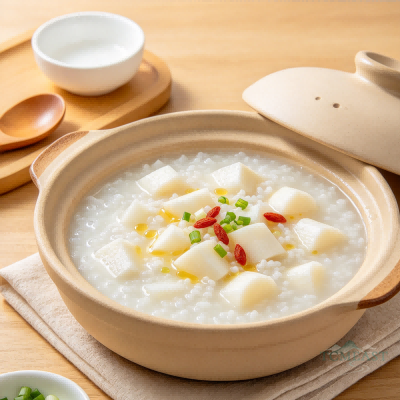
Main Ingredients
- White radish (daikon) 200g
- Chinese yam 200g
- Japonica rice 100g
- Fresh ginger 2-3 slices
- Chopped green onion a little
- Salt to taste
- White pepper powder a pinch
- Sesame oil 2-3 drops
- Goji berries 10 pieces
- Dried tangerine peel 1 small piece
Steps
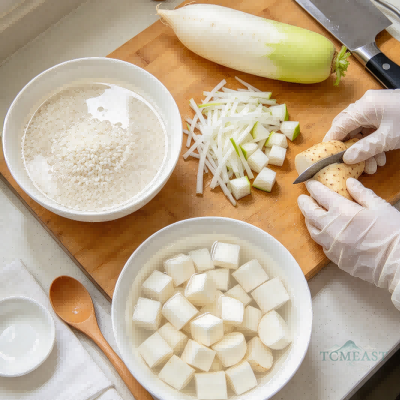
Rinse 100g of japonica rice and soak for 30 minutes for a creamier texture. Wash 200g of white radish. Some skin can be retained. Cut into thin shreds or small dice. For those with Spleen-Stomach Cold, peel to reduce the cool nature. Wear gloves to peel 200g of Chinese yam. Cut into 2-3cm roll-cut chunks or small slices. Immediately place in clean water to prevent oxidation.
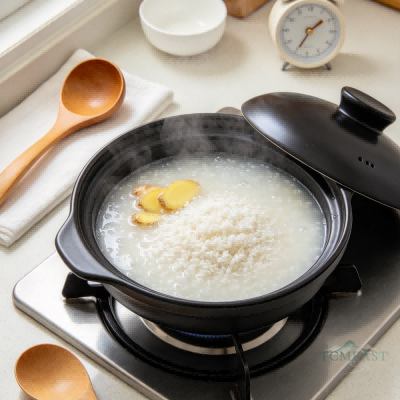
Place the soaked rice in a clay pot or regular pot with about 1000-1200ml of water. Add 2-3 slices of ginger. Bring to a boil over high heat, then reduce to low heat, cover with a small gap, and simmer for 20-30 minutes until the rice blooms.
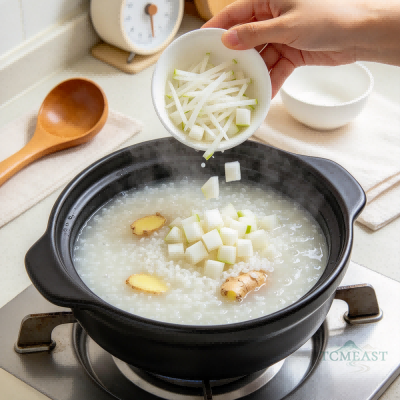
Add the radish shreds or dice and continue simmering over low heat for 10 minutes until softened.
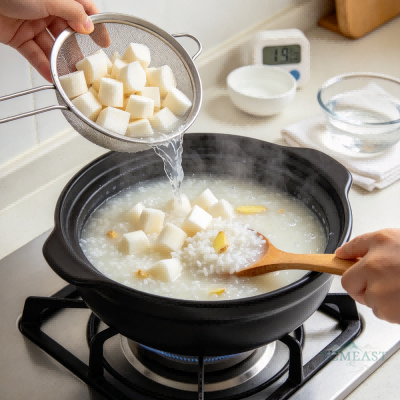
Remove the yam from the water and add to the pot. Continue simmering over low heat for 15-20 minutes until the yam is tender and the congee is thick. Stir occasionally to prevent sticking.
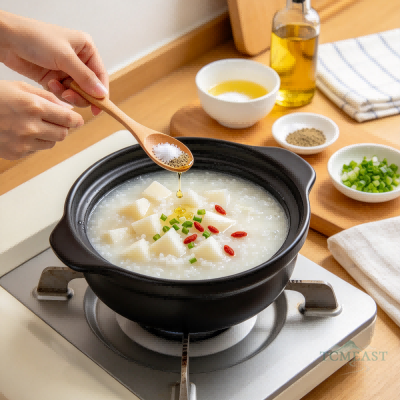
Add salt to taste, a pinch of white pepper, chopped green onion, and 2-3 drops of sesame oil. If using goji berries, add them 5 minutes before turning off the heat. Add salt at the end to prevent the radish from releasing too much water. Consume warm, 1-2 times daily, about 1 bowl (250-300ml) per serving. Healthy individuals should consume 2-3 times per week.
TCM Notes
White Radish (Daikon): Contains approximately 16-20 kcal per 100g, with over 94% water content. Rich in vitamin C, dietary fiber, glucosinolates, amylase, and minerals including potassium and calcium. Known for descending qi, aiding digestion, resolving phlegm, moistening the lungs, detoxifying, generating fluids, promoting diuresis, and relieving constipation. Glucosinolates help promote digestion and dilute respiratory mucus; amylase aids starch digestion; dietary fiber promotes intestinal motility. Chinese Yam: Contains approximately 1.9g protein, 12.4g carbohydrates, and 0.8g dietary fiber per 100g. Rich in mucilage protein, amylase, polyphenol oxidase, saponins, vitamin C, and minerals including potassium and magnesium. Known for strengthening the spleen, benefiting the stomach, nourishing the kidneys, and boosting qi. Mucilage protein protects the gastric mucosa, and amylase aids starch digestion. Japonica Rice: Sweet in taste, neutral in nature; enters the Spleen, Stomach, and Lung meridians. Known for tonifying the middle, boosting qi, and strengthening the spleen and stomach, enhancing the effects of white radish and Chinese yam while ensuring the digestion-promoting action does not harm the body’s integrity. Synergistic Effect: White radish descends qi, promotes digestion, resolves phlegm, and moistens the lungs; Chinese yam strengthens the spleen, benefits the stomach, and tonifies qi and yin; japonica rice tonifies the middle and protects the stomach. One promotes digestion, one tonifies, one nourishes—promoting digestion without harming the spleen and stomach, and tonifying deficiency without retaining stagnation. Total approx. 350-420 kcal, primarily carbohydrates—a low-fat, high-fiber spleen-strengthening and digestion-promoting wellness congee.
Suitable for:Those with weak spleen, poor appetite, and indigestion Those with food stagnation, abdominal bloating, acid regurgitation, and post-meal fullness Those with cough and excessive phlegm, white or sticky phlegm, and dry throat Those needing lung-moistening, phlegm-resolving, spleen-strengthening, and stomach-nourishing support in autumn and winter The elderly, children, and those in post-illness recovery needing easily digestible food General population for daily spleen-strengthening, digestion-promoting, and digestive support
Not suitable for:Those with Spleen-Stomach Cold Deficiency – use with caution. White radish is slightly cool; those with cold intolerance, easy diarrhea, or abdominal cold pain should not consume much. Add 2-3 slices of ginger, 1 small piece of tangerine peel, or 3-5 red dates to balance the cool nature. Those with diarrhea or loose stools – use with caution. White radish is high in fiber and slightly cool, which may worsen diarrhea. Those taking qi-tonifying herbs such as ginseng or astragalus – avoid concurrent use. Traditionally, white radish “descends qi” and may weaken the effects of qi-tonifying herbs. Diabetes patients – use with caution. Rice congee has a relatively high glycemic index; control portion size, reduce staple food accordingly, and monitor blood glucose. Those with wind-cold cough or white thin phlegm – use with caution. White radish is cool in nature and may worsen cold cough; consult a doctor if unsure. Those with thyroid disorders – white radish contains glucosinolates, which may affect iodine absorption. Those with abnormal thyroid function should consume in moderation and avoid long-term heavy consumption. Those with gastric ulcers or hyperacidity – use with caution. White radish may stimulate gastric acid secretion; try small amounts. Those allergic to white radish, Chinese yam, or japonica rice – avoid. Those with sensitive skin to Chinese yam – wear gloves when handling Chinese yam to avoid skin irritation from the mucilage.