
Soups
Mung Bean, Coix Seed & Chinese Yam Soup
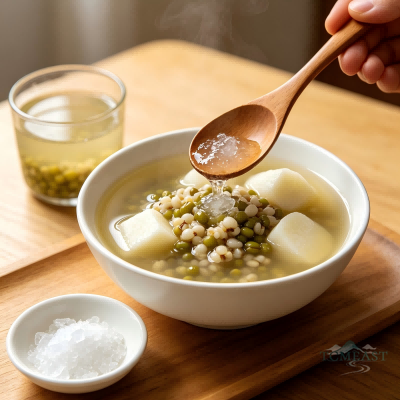
Mung Bean, Coix Seed & Chinese Yam Soup is a classic summer wellness soup that combines clearing heat, relieving summer heat, strengthening the spleen, draining dampness, and nourishing the stomach. Mung beans are cold in nature and sweet in taste, entering the Heart and Stomach meridians, known for clearing heat, detoxifying, relieving summer heat, promoting diuresis, and quenching thirst. Coix seeds are cool in nature and sweet-bland in taste, entering the Spleen, Stomach, and Lung meridians, known for strengthening the spleen, draining dampness, clearing heat, draining pus, and reducing edema. Chinese yam is neutral in nature and sweet in taste, entering the Spleen, Lung, and Kidney meridians, known for strengthening the spleen, benefiting the stomach, nourishing the kidneys, and boosting qi. Together, mung beans clear summer heat, coix seeds drain dampness, and Chinese yam strengthens the spleen. The soup achieves the effects of clearing summer heat, strengthening the spleen, draining dampness, reducing edema, and generating fluids. The broth is clear with a light green tint, the mung beans are soft and blooming, the coix seeds are tender, and the yam is mildly sweet. It is especially suitable for summer dampness, weak spleen with dampness, edema, and poor appetite.
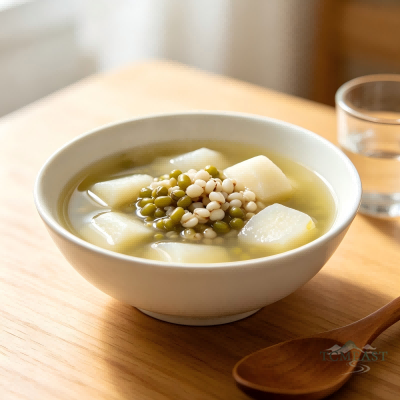
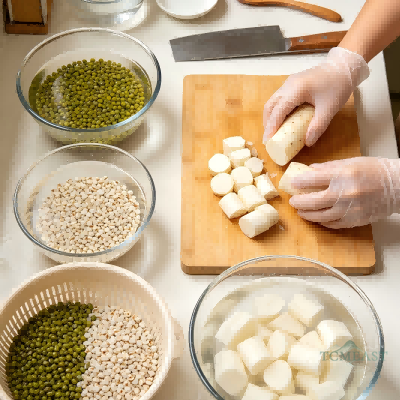
Main Ingredients
- Mung beans 80-100g
- Coix seeds (Job’s tears) 50-80g
- Chinese yam 200-300g
- Dried tangerine peel 1 small piece
- Fresh ginger 2-3 slices
- Rock sugar to taste
- Water 1200-1500ml
Steps
Rinse 80-100g of mung beans and 50-80g of coix seeds separately, removing any bad beans. Soak mung beans in water for 2-4 hours and coix seeds for 2-4 hours or overnight until expanded. Drain and set aside. Rinse 80-100g of mung beans and 50-80g of coix seeds separately, removing any bad beans. Soak mung beans in water for 2-4 hours and coix seeds for 2-4 hours or overnight until expanded. Drain and set aside.
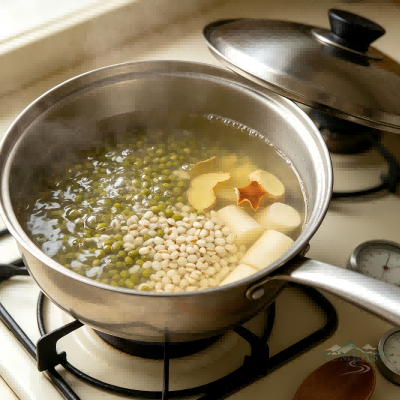
Place the soaked mung beans and coix seeds in a pot with about 1200-1500ml of water. Add 1 small piece of tangerine peel or 2-3 slices of ginger if desired. Bring to a boil over high heat, then reduce to low heat, cover with a small gap, and simmer for 40-50 minutes until the mung beans bloom and the coix seeds are tender.
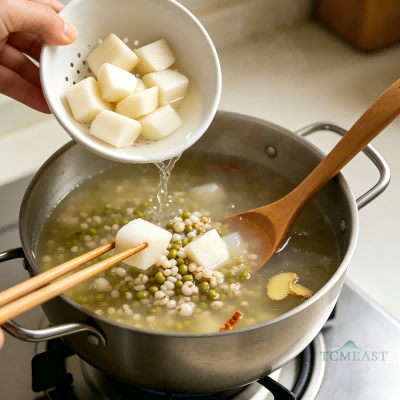
Remove the yam from the water and add to the pot. Continue simmering over low heat for 15-20 minutes until the yam is tender and easily pierced with a fork.
Add rock sugar to taste (optional) and stir until fully dissolved. Turn off the heat. Serve warm or chilled. 1-2 times daily, about 1 bowl (200-300ml) per serving. Healthy individuals should consume 2-3 times per week.
TCM Notes
Mung Beans: Contain approximately 21.6g protein, 62g carbohydrates, and 6.4g dietary fiber per 100g. Rich in B vitamins, potassium, magnesium, calcium, and iron. Known for clearing heat, detoxifying, relieving summer heat, promoting diuresis, and quenching thirst. Modern research shows lipid-lowering, liver-protective, and anti-allergic effects. Coix Seeds (Job’s Tears): Contain approximately 12.8g protein, 3.3g fat, 71.1g carbohydrates, and 2g dietary fiber per 100g. Rich in B vitamins, vitamin E, and minerals including calcium, phosphorus, and iron. Known for strengthening the spleen, draining dampness, clearing heat, draining pus, and reducing edema. Coix seeds are a low-GI food (GI approximately 55), suitable as part of a staple food replacement. Chinese Yam: Contains approximately 1.9g protein, 12.4g carbohydrates, and 0.8g dietary fiber per 100g. Rich in mucilage protein, amylase, polyphenol oxidase, saponins, vitamin C, and minerals including potassium and magnesium. Known for strengthening the spleen, benefiting the stomach, nourishing the kidneys, and boosting qi. Mucilage protein protects the gastric mucosa, and amylase aids starch digestion. Synergistic Effect: Mung beans clear summer heat; coix seeds strengthen the spleen and drain dampness; Chinese yam strengthens the spleen and nourishes the stomach. One clears, one drains, one tonifies—clearing without harming the body, draining without damaging yin, and tonifying without being cloying. Total approx. 300-400 kcal (unsweetened), primarily carbohydrates—a low-fat, high-fiber heat-clearing, dampness-draining, and spleen-strengthening soup.
Suitable for:Those with summer dampness, body heaviness, dry mouth, and scanty dark urine Those with weak spleen and dampness, poor appetite, indigestion, and loose stools Those with edema, difficult urination, and morning eyelid puffiness Those with oily skin, acne, or eczema due to damp-heat (adjunctive support) Those with hypertension and hyperlipidemia (adjunctive support) Those needing to clear summer heat, strengthen the spleen, and drain dampness General population for summer wellness
Not suitable for:Pregnant women – avoid or use with caution. Coix seeds are slippery in nature; pharmacological studies show they stimulate uterine smooth muscle and may induce contractions, potentially increasing the risk of miscarriage. Avoid large amounts, especially in early pregnancy. Those with Spleen-Stomach Cold Deficiency – mung beans and coix seeds are cooling in nature; those with cold intolerance, easy diarrhea, or abdominal cold pain should not consume much. Add 2-3 slices of ginger, 1 small piece of tangerine peel, or 3-5 red dates to balance the cold nature. Women during menstruation – mung beans and coix seeds are cooling; excessive consumption may worsen menstrual discomfort or dysmenorrhea. Those with diarrhea or loose stools – mung beans and coix seeds are high in fiber and cooling, which may worsen diarrhea. Acute gout / hyperuricemia patients – mung beans and coix seeds have moderate purine content; purines dissolve into the soup. Avoid during acute flare-ups; during remission, consume sparingly and discard the broth. Diabetes patients – omit rock sugar and control mung bean and coix seed portions, reducing staple food accordingly. Those with renal insufficiency – mung beans and coix seeds are high in potassium; portion size must be under medical guidance. Those taking Chinese or Western medication – mung beans have detoxifying effects and may reduce drug efficacy; avoid within 1-2 hours of taking medication. Those allergic to mung beans, coix seeds, or Chinese yam. Those with sensitive skin to yam – wear gloves when handling yam to avoid skin irritation from the mucilage.