
Herbal Teas
White Radish, Pear & Honey Water
White Radish, Pear & Honey Water is a classic folk remedy for moistening the lungs, relieving cough, clearing heat, and resolving phlegm. White radish descends qi, aids digestion, resolves phlegm, and moistens the lungs. Pear clears heat, generates fluids, moistens dryness, and resolves phlegm. Honey tonifies the middle, moistens dryness, and relieves cough. Together, white radish resolves phlegm and descends qi, pear clears heat and moistens the lungs, and honey moistens dryness and relieves cough. The drink achieves the effects of moistening the lungs, relieving cough, clearing heat, resolving phlegm, generating fluids, moistening dryness, descending qi, and aiding digestion. It is sweet and smooth, carrying the fresh aroma of white radish, the fruity note of pear, and the mellow sweetness of honey. It is especially suitable for dry autumn and winter seasons or for those with lung-heat dry cough, dry cough with little phlegm, and dry sore throat.
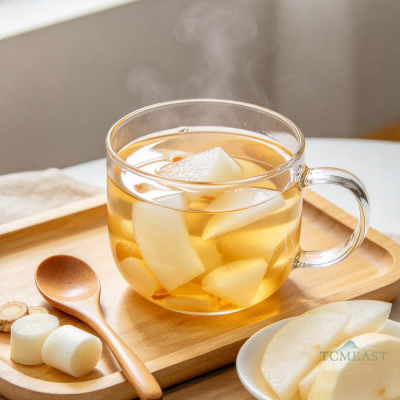
Main Ingredients
- White radish (daikon) 200-300g
- Pear 1-2 pieces
- Honey 30-50g
- Warm water as needed
- Dried tangerine peel 3-5g
- Fresh ginger 1-2 slices
- Goji berries 5-10 pieces
Steps
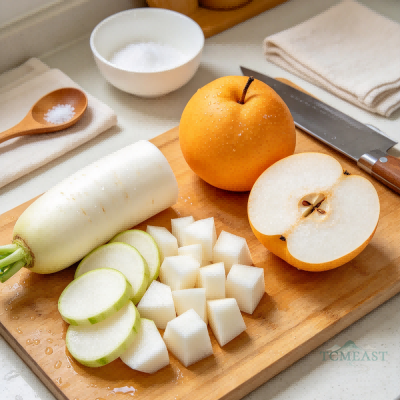
Wash 200-300g of white radish, peel or retain some skin, and cut into thin slices or small chunks. For those with Spleen-Stomach Cold, peeling is recommended to reduce the cool nature. Wash 1-2 pears, keep the skin on (scrub with fine salt to clean), remove the core, and cut into small pieces. Peel if you prefer a smoother texture.
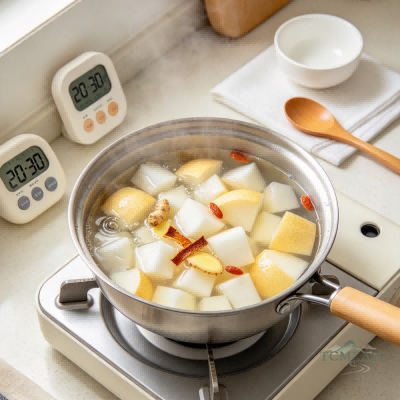
Place radish chunks and pear pieces in a pot with about 800-1000ml of water. If using 3-5g dried tangerine peel or 1-2 slices of ginger, add them now. Bring to a boil, then simmer over low heat for 20-30 minutes until the radish and pear are soft and the liquid is slightly white. Turn off the heat and cool to 40-50°C (comfortable to drink). Note: Honey should not be exposed to high heat, which destroys its active enzymes and nutrients.
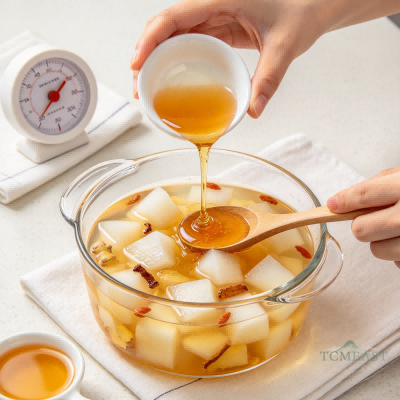
Add 30-50g of honey and stir until fully dissolved. Drink the liquid and eat the radish and pear. 2-3 times daily, warm. Take for 2-3 consecutive days as one course.
TCM Notes
White Radish (Daikon): Contains approximately 16-20 kcal per 100g, with over 94% water content. Rich in vitamin C, dietary fiber, glucosinolates, amylase, and minerals including potassium and calcium. Known for descending qi, aiding digestion, resolving phlegm, moistening the lungs, detoxifying, generating fluids, promoting diuresis, and relieving constipation. Glucosinolates help with antibacterial action and digestion; amylase aids starch digestion; dietary fiber promotes intestinal motility. Pear: Contains approximately 40-50 kcal per 100g, with over 85% water content. Rich in vitamin C, dietary fiber, pectin, potassium, and various organic acids. Known for clearing heat, generating fluids, moistening dryness, resolving phlegm, and nourishing the heart and lungs. Pectin helps protect the gastric mucosa, and organic acids stimulate digestive juice secretion. Honey: Mainly contains fructose and glucose (about 70%-80%), various enzymes, organic acids, vitamins, and minerals. Known for tonifying the middle, moistening dryness, relieving pain, and detoxifying. Its viscous texture forms a protective layer on the throat mucosa, relieving dry cough irritation. Synergistic Effect: White radish descends qi, resolves phlegm, clears heat, and generates fluids; pear clears heat, moistens the lungs, and resolves phlegm; honey moistens the lungs, relieves cough, tonifies the middle, and moistens dryness. One clears, one moistens, one transforms—clearing heat without harming the body, moistening the lungs without causing stagnation, and resolving phlegm without damaging fluids. Total approx. 150-220 kcal (depending on honey amount)—a low-fat, lung-moistening, phlegm-resolving dietary drink.
Suitable for:Those with lung-heat dry cough, dry cough with little phlegm, dry throat, and itchy throat Those with phlegm-heat cough, yellow thick phlegm, and difficult expectoration Those with throat discomfort and hoarseness during dry autumn and winter Those in the late stage of wind-heat colds with residual heat, cough, and dry throat Those with dry throat after smoking or drinking alcohol Those with indigestion, food stagnation, abdominal bloating, and constipation General population for autumn-winter dryness relief and daily wellness
Not suitable for:Infants under 1 year old – absolutely no honey – honey may contain Clostridium botulinum spores; infants under 1 year have an immature gut microbiome and may develop infant botulism. This is the most important safety contraindication. Those with wind-cold cough – avoid. Symptoms include white thin phlegm, chills, clear runny nose, itchy throat, and worsening with cold. Both white radish and pear are cool in nature and may worsen cold cough. Those with Spleen-Stomach Cold Deficiency or prone to diarrhea – use with caution. Both white radish and pear are cool in nature; those with cold intolerance, diarrhea, or abdominal cold pain may worsen symptoms. Add 2-3 slices of ginger to balance the cool nature. Diabetes patients – use with caution or avoid. Honey is high in sugar and raises blood glucose quickly; strictly control intake or consult a doctor for sugar substitutes. Those with gastric ulcers or hyperacidity – use with caution. Both white radish and pear may stimulate gastric acid secretion; try small amounts. Those taking qi-tonifying herbs such as ginseng or astragalus – avoid concurrent use. Traditionally, white radish “descends qi” and may weaken the effects of qi-tonifying herbs. Those allergic to white radish, pear, or honey – avoid. Pregnant women – use with caution. Pear and white radish are cool in nature; avoid large amounts and consult a doctor. Those taking anticoagulant medications – use with caution. White radish contains vitamin K, which may affect anticoagulant efficacy; consult a doctor.